CategoriesInsights

PROCUREMENT IN AUTOMOTIVE: Power, Process and the Cost of Standing Still

This report is kindly sponsored by Tawin Holdings Limited.
Introduction: Why Procurement, Why Now 

For much of the automotive industry’s recent history, logistics has taken the headlines. Just-in-time supply chains, factory shutdowns, container crises, semiconductor shortages — these are, at their most visible, logistics stories. But behind every logistics decision sits a procurement decision. And it is in procurement that some of the industry’s most important — and least talked about — changes are now happening. 

This report does not claim to be a statistical survey. It is a collection of honest views from people who have worked at the highest levels of automotive procurement, people who have left the industry and now see it from the outside, and people who have spent their careers on the supplier side trying to understand how procurement decisions are made. 

The picture that comes through is of a function under real pressure from several directions at the same time. Tariff changes, supplier financial problems, new technology including AI, the shift to electric vehicles, changing power between car makers and their suppliers, and a growing gap between following the right process and getting the right outcome — these are all happening together. How procurement teams respond will shape not just their own organisations, but the entire supply chains they manage. 

The report covers seven main themes, each drawn from what people told us. It ends with a set of questions the industry should be asking itself. 

1. The Procurement Power Question 

Ask senior supply chain executives where procurement sits in their organisation and you will get very different answers. The honest answer is: it depends entirely on the person and the structure they work within. 

In some organisations, the procurement or purchasing leader is a real decision-maker — someone with the power to understand the full commercial picture, give ground in a negotiation in real time, and make judgements that go beyond the numbers. They can sit across the table from a supplier and close a deal on the spot. These people are rare, and those who have worked with them say the difference is huge. 

“He can make a decision at the table and say — it’s done. I give you a reduction there, I get something there. Nobody is close to that.” 
— Senior industry executive 

But this is the exception. Across most of the industry, procurement has become a function focused on following the right process rather than getting the right commercial outcome. The measure of success is whether the process was followed correctly — not whether the result was the best one. 

This matters because the best procurement leaders see their role as much broader than negotiating and managing contracts. The most effective are those who act as connectors — linking what suppliers can offer with what the business actually needs, speaking up for suppliers when they are not in the room, and making sure that commercial relationships are built on real mutual benefit rather than just leverage. 

“The power you have in procurement is just on loan. It comes from your position and your budget responsibility. If you are not reliable — if you don’t do what you say — people will find ways around you.” 
— Senior procurement executive, ex-OEM 

The difference between procurement and purchasing — which many experienced practitioners draw carefully — is worth noting here. Purchasing, in its simplest form, is about execution: negotiating rates, issuing purchase orders, managing the mechanics of a transaction. Procurement, when done properly, is strategic: it shapes how an organisation finds and works with suppliers, builds relationships, and creates value across a supply chain. In many automotive organisations, the two words are used to mean the same thing — and that confusion itself says something about how the function is seen. 

2. When the Process Replaces the Judgment 

One of the biggest structural changes in automotive procurement over the past decade has been the move to automated sourcing systems — most commonly Dutch auction platforms — at several major car makers. The idea makes sense on paper: remove human bias, create a transparent and fair process, ensure compliance. In practice, the results are more complicated. 

Under these systems, once a supplier has passed the technical and operational checks — a process that requires sign-off from operations, logistics and purchasing — the commercial result is decided by an algorithm. Rounds of bidding continue until a winner emerges. In many cases, procurement staff are there in name only. 

“Purchasing is sitting in the room. They put a piece of paper on the table and say you can sign or not. There are rounds — back and forth. But you are never in a real commercial conversation. That is completely gone.” 
— Senior logistics executive 

There are people who defend this approach. Getting sign-off from operations, logistics and purchasing together does at least mean that the worst outcomes — giving business to a supplier who cannot actually do the job — are supposed to be stopped at the qualification stage. But even this does not always work. Whether a supplier can really perform in the real world is not always visible at the qualification stage. And when things go wrong, the procurement team that ran the process is rarely the one left managing the consequences. 

“They called us last year twice because the supplier couldn’t operate the business anymore. And now they’ve awarded the same business to the same people again.” 
— Senior industry executive 

What is most difficult to defend is what these systems do to the skills inside the organisation. When procurement is reduced to managing a process, people stop learning how to negotiate commercially. The ability to understand a supplier, structure a deal, and find where value can be created or saved — these skills are not kept alive if they are never used. The organisation becomes dependent on the system and loses the ability to question whether it is working. 

“You come up with good business cases to outsource stuff — and then you forget how to buy it. There is a pendulum there, and most companies don’t notice when they’ve swung too far.” 
— Cross-industry supply chain executive 

This is not an argument against having clear, well-run processes. Transparent sourcing matters — especially at scale. But there is a real difference between a process that supports commercial judgment and one that replaces it. The best procurement organisations understand that. Many do not. 

3. The Changing Balance Between Car Makers and Suppliers 

For most of the past thirty years, car makers held the power in their relationships with suppliers. They had the volume, set the terms, and — particularly in logistics — treated their supply base as an extension of their own operations rather than as independent partners. The relationship was designed to be transactional, and suppliers largely accepted it. 

That is changing. Supplier margins have, for the first time since 2019, gone above OEM margins in several parts of the industry. Years of outsourcing — manufacturing, IT, logistics operations — have in some cases left car makers less able to judge what they are buying than the suppliers they are negotiating with. And as vehicles have become more technology-driven, car makers have found themselves sourcing from suppliers — in chips, software, battery technology — who do not need the automotive relationship and can choose their customers. 

“We used to teach new technology suppliers how to supply the automotive industry. Now we need to learn how to purchase from them.” 
— Industry observer 

This has real implications for procurement. Negotiating from a position of power — the model that defined automotive purchasing for a generation — is becoming less effective precisely where it matters most. A semiconductor supplier that also serves Apple and Samsung is not going to worry too much about losing one car maker’s business. A logistics provider that can choose between customers during tight capacity periods will remember which ones treated them well. 

“If suppliers always feel they’re getting ripped off, the next time you go out to market, they won’t be interested. The market has changed. Suppliers can now choose who to work with.” 
— Senior procurement executive, ex-OEM 

The most forward-thinking procurement leaders have recognised this shift and changed how they work. They invest in being a good customer — in building relationships that make suppliers want to give them priority, share information early, and bring new ideas without being asked. This requires a very different approach from traditional automotive procurement, and it requires people who can work with suppliers as partners, not just as counterparts in a negotiation. 

WHAT PRACTITIONERS SAY 
  • “More consolidation of logistics business within big providers — reducing the options for buyers.” — Tier 1 procurement executive 
  • “Supplier insolvencies, cost-down pressure, and quality concerns driven by global supply disruptions.” — OEM Tier 1 supplier 
  • “Cost pressure versus supply-base survival. Procurement is being forced into a defensive, firefighting role.” — Senior industry analyst 
4. The Tender Process Problem — and the Case for a Better Approach 

One of the most consistent complaints from logistics service providers — and one that the more honest procurement leaders acknowledge — is that the standard tender process makes it very hard for suppliers to bring new ideas to the table. When a tender document runs to sixty pages of tightly defined specifications, the message it sends is clear: tell us you can do exactly what we have already decided we want. The result is a process that rewards the ability to match a specification rather than the ability to solve a problem. 

This is not always wrong. For straightforward services with well-understood requirements and stable volumes, a tight, well-defined tender process is efficient and fair. The problem is that very little in automotive logistics fits that description today. Volumes change. Origins and destinations shift. Trade rules change. What looks like a stable requirement when the tender goes out can look very different eighteen months into a contract. 

“If you have a very closed tender with very defined specifications, that is absolutely normal when you buy a product that needs to perform in the same way for many years. But in our world of supply chain, everything changes. We need to be open-ended.” 
— Global head of procurement, major OEM 

The better approach — which some leading procurement teams are already using — is to design tenders that ask a different question of suppliers: not ‘can you do what we have specified?’ but ‘how would you solve this problem?’ This creates space for suppliers to bring their own knowledge of what works, their technology, and their understanding of the market. It produces better outcomes. And it builds the kind of relationship where a supplier will come to you early when something is going wrong — rather than staying quiet and hoping you won’t notice. 

“Tenders and RFQs should be the end of a process that started much earlier — where you are in regular contact, you understand what the supplier is working on, and you have already learned from other industries. The formal process should confirm a relationship, not start one.” 
— Global head of procurement, major OEM 

From the supplier side, the practical message is clear: a tender process is not the right moment to present an innovation unless it directly saves cost. The right approach is to bid competitively on what has been asked, secure the relationship, and then build the case for additional value once you are working together. Getting onto the tender list in the first place is often the hardest step — and it requires patience, a clear value proposition, and a real understanding of how the buying cycle works. 

“Ask your client about their planning cycle — when are they going to go out for tender, so you know when to follow up. The curve starts slowly. But if you are really performing, you can get a lot of business.” 
— Senior procurement consultant, ex-OEM 

On the question of who to build the relationship with — the head of supply chain, the head of logistics, or the procurement buyer — the answer depends on the organisation. In companies where procurement is genuinely strategic, the buyer is the most important relationship; they have good reasons to keep their tender lists competitive and the ability to support you internally. In organisations where purchasing is mainly an execution function, the real decision-maker sits in supply chain or operations, and that is where the relationship needs to be. 

5. Tariffs, Trade Changes and the Flexibility Gap 

The tariff situation of 2024-25 has tested automotive procurement in ways that normal trading conditions do not. As trade policy has shifted — new export controls, revised product classifications, threatened and actual tariffs on goods from Mexico, Canada and China — the gap between how automotive procurement works and how it needs to work has become very clear. 

The core problem is structural. A car maker cannot move a production line because a tariff changes. The factory is where it is. The tooling costs have already been paid. The supplier contracts were often signed before the current trade situation even existed. This is not carelessness — it is simply the nature of large-scale manufacturing. But it does mean that automotive procurement is operating in a world it was not designed for. 

The contrast with other industries is instructive. In consumer goods and fashion, where sourcing volumes can be moved between countries relatively quickly, companies have shown a real ability to respond to tariff changes — not without pain, but at a speed that automotive cannot match. 

“In fashion, there is room to move how you allocate sourcing volumes. Different countries are taxed in different ways and you can shift. In automotive, you have a factory in a country. You are much more fixed. You are not flexible.” 
— VP Global Logistics, major consumer brand 

For automotive procurement, the practical lesson is not that factories should be easier to relocate — they cannot be. It is that the data around sourcing decisions needs to be good enough to model the impact of a change quickly. Which product classifications apply to which supplier flows? What is the total cost impact of a 25% tariff on components from a given country? How quickly can procurement work out the alternatives? 

“New export controls on 30 product categories out of Mexico. How quickly can your company work that out? If you have the data accessible, it takes five minutes. If you don’t, you are scrambling.” 
— Cross-industry supply chain executive 

Companies that have invested in keeping their trade data in good order — product classifications, commercial invoices, country-of-origin records — have a real advantage in this environment. Those that have not are effectively working without the information they need when trade policy changes, which is now happening more often and less predictably than before. 

The deeper lesson from the tariff situation is about the link between sourcing strategy and commercial outcomes. Automotive procurement has historically been set up to find the lowest cost within a stable trade environment. The environment is no longer stable. The function needs to build a different kind of capability — not just finding the cheapest source, but managing risk, modelling different scenarios, and building flexibility into the supply base where possible. 

WHAT PRACTITIONERS SAY 
  • “Constantly shifting tariffs and trade agreements, forced re-sourcing and supply base changes mid-programme.” — Senior purchasing executive, major OEM 
  • “Minimum order quantities, longer lead times, country protectionism and China subsidies.” — Procurement director, Tier 1 supplier 
  • “The political pressure to exit China versus the operational impossibility of doing so. Managing exposure rather than pretending to eliminate it.” — Senior industry analyst 
6. Data, Technology and the Information Gap 

There is wide agreement across the industry that AI will change procurement — in how tenders are run, how suppliers are evaluated, how risks are spotted, and how decisions are made. There is less agreement, and less honesty, about how far most organisations are from being ready to benefit from it. 

The limiting factor is not the technology. The tools exist and are improving quickly. The limiting factor is data — specifically, whether the data that procurement decisions are based on is complete, well-organised and easy to access. Commercial invoices that are not in digital form. Trade data that is held separately across different parts of the business. Cost information that exists at a high level but not at the level of individual transactions. Product classification records that live in a system nobody can query quickly. These are not unusual problems. They are the normal situation in most large automotive organisations. 

“To use AI well, you need to move from data to information to action. AI is a powerful tool — but only if the data foundation is there. If the data is not strong, you do not get the right information. And if you do not get the right information, you cannot make the right decision.” 
— Global head of procurement, major OEM 

The organisations making real progress have treated data as something strategically important, not just a by-product of operations. Bringing freight procurement together across business units. Building their own tools to check freight invoices. Connecting trade data with logistics data. Making it possible for the people making decisions to access the data they need directly, rather than waiting for a specialist team to produce a report. 

“We built our own freight audit software because I needed the data — 15,000 freight accounts, three parcel companies across the entire world. We were paying pre-COVID prices with no adjustment for inflation. That saving was just sitting there, untouched.” 
— Cross-industry supply chain executive 

The AI opportunity, properly understood, is not about replacing procurement judgment. It is about getting from data to insight faster — so that the person making the decision can spend their time on the decision, not on gathering the information. The organisations that will benefit most are those where the data is already in good shape. For those that have not yet done this work, the gap is growing. 

“AI will be used more and more for tendering, making procurement processes faster. But you need to be much more flexible — and for that you cannot keep working with old, fixed approaches.” 
— Head of logistics purchasing, major OEM 

There is another dimension worth noting: who inside procurement has access to data. In many large organisations, the ability to look at data is restricted to specialist IT or analytics teams — which means procurement people have to wait for information that should be directly available to them. The companies moving fastest are those that have given the people making decisions direct access to the data they need. 

7. Moving From Lowest Cost to Most Reliable 

For most of the past thirty years, the main measure of success in automotive procurement was cost reduction. The job was to pay less for a given input — whether components, logistics services, or other spend — year after year. The assumption behind this was that supply chains were basically stable, that disruptions were rare, and that the main risk was paying too much rather than not getting what you needed at all. 

That assumption no longer holds. The period since 2015 has produced a series of supply chain shocks — geopolitical events, the pandemic, trade policy changes, natural disasters — that have shown how fragile supply chains built purely around cost can be. The question is no longer only ‘how cheaply can we source this?’ but ‘how reliably can we source this, and what happens when we cannot?’ 

“The shift from lowest cost to reliability and speed of response. Dual sourcing, regional backup, having options. Procurement measured on risk management, not just savings.” 
— Senior purchasing executive, major OEM 

In practice, this means organisations are reconsidering things that were previously ruled out on cost grounds. Using more than one supplier for the same service. Building regional backup into the supply chain design. Reconsidering long-term contracts — which had been getting shorter as car makers tried to keep flexibility — as a way to secure priority treatment from key suppliers. 

The tension between reducing costs in the short term and investing in reliability for the long term is real and not yet resolved. Procurement teams are being asked to do both at the same time — objectives that frequently conflict. The organisations handling this best are those where procurement has enough seniority and cross-functional authority to make the case for reliability investment at board level, rather than being managed purely against a cost-saving target. 

“If you are not sure whether to raise something with the board — ask yourself: if I don’t raise this, could something really bad happen? If the answer is yes, pick up the phone. And come with a proposal, not just a problem.” 
— Senior procurement executive, ex-OEM 

Sustainability sits within this picture — and its position is complicated. At board level, the commitment is genuine and the pressure from regulation is real, particularly in Europe. Further down the organisation, the practical reality is that sustainability requirements compete with cost targets that have not been relaxed to make room for them. The result is often a gap between what organisations say they will do and what actually happens — made worse by the fact that there is no single agreed definition of what sustainability in supply chain actually means. 

“As humans we need to survive the short term to get to the long term. For many in procurement, sustainability is still a long-term goal while short-term profitability is the immediate pressure. I don’t think many people want to admit that — but it is true.” 
— Senior procurement consultant, ex-OEM 

WHAT PRACTITIONERS SAY 
  • “EV demand below forecasts. ICE, hybrid and EV portfolios running in parallel. Re-activating supplier relationships that were being wound down.” — Senior purchasing executive 
  • “Sustainability requirements are getting bigger. It’s not just about the car — trucks, everything should be more sustainable. And AI will be central to handling the new flexibility requirements.” — Head of logistics purchasing, major OEM 
  • “Develop our people and our partnerships. This is the foundation for everything else. It is primarily a people challenge, not a technical one.” — Senior procurement executive, major OEM 
8. What Other Industries See When They Look at Automotive 

Some of the sharpest observations about automotive procurement come not from those inside it, but from those who have left it — executives who spent years working inside the industry and have since moved into consumer goods, industrial manufacturing, or advisory roles, and now see the automotive way of doing things from the outside. 

The themes that come up consistently are the same: a function that is strong on process discipline but limited in commercial thinking; that works in separate teams even when the problems it faces require working across functions; and that tends to protect its processes rather than ask whether those processes are producing the right results. 

“In automotive there is a real pride in manufacturing capability — but then we forget that we actually want to sell something. You cannot work in your own silo. You always need to think one step ahead.” 
— VP Global Logistics, ex-automotive, now consumer goods 

The difference in commercial culture is striking to people who have experienced both. In consumer goods, the willingness to go beyond a budget when a market opportunity appears — to put money where it is needed rather than where it was planned — is a normal way of working. In automotive, the instinct is to defend the plan. 

“If we see we can generate higher sales or capture market share, we will go over the budget and put capital where it is needed. I found it much harder in automotive to find that kind of flexibility.” 
— VP Global Logistics, ex-automotive, now consumer goods 

Cross-industry movement in procurement and supply chain is still relatively uncommon in automotive — less common than in logistics, where some executives have made the move successfully. Those who have moved say consistently that their automotive discipline — lean thinking, risk management, resilience planning, data rigour — is highly valued in other sectors. The reverse — bringing commercial flexibility and a stronger focus on the end customer from other industries into automotive procurement — happens less often, and is arguably more needed. 

“If the company is open to getting a fresh perspective on how supply chain can be managed, it is a very good fit. But if the company is closed to new ideas and you can see a better way but cannot make it happen — that is where people get frustrated.” 
— VP Global Logistics, ex-automotive, now consumer goods 

9. People, Skills and Getting the Right Team 

Changing automotive procurement — from a cost-reduction function to a genuinely strategic capability — requires people with a different set of skills from those the function has traditionally recruited and developed. The skills that matter most now sit at the intersection of commercial judgment, the ability to work with data, the ability to influence people across different functions, and the ability to adapt quickly. These are not the skills that a standard automotive procurement career path has traditionally built. 

“We limit ourselves too much. We look for a specific number of years of experience in a very specific area. I think we could not be more wrong about that.” 
— Cross-industry supply chain executive 

The most effective procurement professionals described in this research share several characteristics. They are genuinely interested in how their suppliers’ businesses work — what a logistics provider actually does, what limits them, and what they know that the buying organisation does not. They are comfortable making decisions without having all the information. They understand how data moves through the systems they work with — not as a software developer, but well enough to know what data is available, where it is, and how it can be used. And they can get things done through people who do not report to them and may not naturally want to work with them. 

“Procurement puts you in contact with everything — finance, logistics, supply chain, sales. How do you influence people without having any authority over them? That is also a sales skill. And once you learn it, nothing scares you anymore.” 
— Senior procurement executive, ex-OEM 

The talent question also covers how organisations develop and keep good procurement people. The function tends to be invisible when it is working well — which makes it hard to make the case for investment in people and capability at board level. The organisations that have built strong procurement functions are those where leadership has recognised that procurement capability is not a back-office concern but a real competitive advantage. 

“Procurement leaders are increasingly coming from supply chain roles. A broader understanding of operations, manufacturing and logistics is becoming necessary. Procurement needs to be seen as critical infrastructure — not a back-office function.” 
— Senior purchasing executive, major OEM 

For people starting out in the field, the message is a positive one: procurement offers real breadth of exposure, significant responsibility early in a career, and skills that transfer across industries and functions. The challenge — and the opportunity — is that the function is changing faster than most organisations’ development programmes have kept up with. 

Conclusion: Questions the Industry Should Be Asking 

The evidence in this report points to a function under significant pressure from several directions at once. Tariff changes, supplier financial difficulties, new technology, the energy transition, shifting power between car makers and suppliers, and a growing gap between following the right process and getting the right outcome — these are all happening at the same time, and they affect each other. 

The organisations that will handle this well are not necessarily those with the most advanced technology or the largest procurement teams. They are those with the clearest sense of what procurement is actually for — and the honesty and courage to close the gap between what their processes produce and what their supply chains need. 

The following questions are offered as a starting point for honest internal discussion: 

On commercial capability: 
  • Do our procurement processes produce good commercial outcomes — or just compliant ones? 
  • Can our procurement leaders negotiate effectively — or have we designed that capability out of the process? 
  • Do we know which of our key suppliers would choose to work with us if they had a genuine choice? 
On data and technology: 
  • If a major tariff change happened today, how quickly could we model the impact on our supplier flows? 
  • Is our procurement data organised well enough to benefit from AI — or would we be building on weak foundations? 
On resilience and strategy: 
  • Are we measuring procurement on the right things — or optimising for a world that no longer exists? 
  • Do our procurement people have enough seniority and cross-functional authority to raise issues at the level where they can be addressed? 
  • Are we a preferred customer — or do we assume our volume is enough? 

 These are not comfortable questions. But they are the right ones. The cost of not asking them is already visible in the gap between what automotive procurement says it does and what it actually produces. Closing that gap is the work of the next few years — and it starts with honesty about where the function is today. 

— LConnect, 2026

CategoriesInsights

Automotive Logistics: 1998 to now

Back in 1998, for the very first issue of Automotive Logistics Magazine, I carried out a series of interviews with senior logistics and supply chain leaders from Chrysler, Ford Motor Company, General Motors and Volkswagen Group.

At the time, logistics was being described as the next big challenge for the automotive industry.

Looking back now, what stands out is how much of the thinking was already there.

Across all the interviews, the same themes kept coming up. How to move from regional to global supply chains. How to connect everything through IT. How to reduce order-to-delivery time. How to better link sourcing, manufacturing and distribution. And what role logistics providers should really play.

Those were the questions then. They still are.

At Chrysler, through Dave Hodgson, there was a strong focus on starting with the customer. Everything should be driven by real demand. They were already linking dealer orders directly into production, sharing plans with suppliers well in advance, and reducing inventory to a minimum. The aim was simple: build what the customer wants, and get it to them quickly.

At Ford, Ray Pittman described something more ambitious. The goal was to run logistics as one global system. Central planning, shared systems, real-time information, and a clear target of reducing order-to-delivery time to around 15 days. One point he made still stands out: logistics needs to be involved at the beginning, not added on later.

At General Motors, Nick Matich talked about a shift in thinking. Logistics was no longer just supporting manufacturing. It was becoming part of how the company competes. He emphasised looking at the whole system, not just individual parts, and focusing on total cost, speed and flow. He also talked about moving away from “make and sell” towards something more responsive to real demand.

Volkswagen, through Johannes Fritzen, highlighted something else that feels very familiar today. Increasing product complexity and globalisation were going to drive much more movement across the supply chain. More parts, more flows between plants, more pressure on logistics. And with that, a growing need for better systems and better coordination.

Behind all of this was the influence of the Toyota Production System. Build to demand, reduce waste, keep things flowing, work closely with suppliers. What the other manufacturers were trying to do was extend those ideas beyond the factory into the full supply chain.

Looking at it now, nearly 30 years later, the interesting thing is not how much has changed, but how much hasn’t.

We are still talking about end-to-end supply chains. We are still trying to improve visibility. We are still working to reduce lead times. And we are still balancing global scale with regional realities.

The vision was already clear in 1998.

The challenge has been making it work in practice.

Logistics was described then as the final frontier.

In many ways, it still is.

Below are the articles themselves from the 1st issue of a magazine, simply called Automotive Logistics.

With thanks to Ryder, our heritage partner, for this retrospective feature. 
CategoriesInsights

China Speed: Automotive Logistics Moves Beyond Export

April 2026  |  Insights

I was recently in Shanghai at the automotive logistics conference organised by the China Federation of Logistics and Purchasing.
 
A lot of presentations, but as ever some of the interesting parts was the conversations around it.
 
One thing stood out.
 
Outside China, people still tend to explain success with cost or policy support. That’s part of it, but it misses something important — the speed at which things are actually being done.
 
Decisions are made quickly.
Markets are entered in parallel.
Supply chains are being built while volumes are already moving.
 
That “China speed” creates a very different challenge for logistics.
 
Capacity has to be secured earlier.
Networks are not built step by step — they’re built while they’re already running.
And when something goes wrong, it shows up immediately.
 
Behind the growth, capacity — especially in shipping — still feels tight and reactive.
 
At the same time, the model is changing.
 
It’s no longer just about exporting vehicles from China. More and more, it’s about building local operations — production, supply chains, and support — in multiple regions at the same time.
 
Latin America, the Middle East, parts of Europe — all growing, all different, all adding complexity.
 
I heard it put quite simply:
“We used to plan exports. Now we plan local operations.”
 
That shift is also changing the role of logistics.
 
It’s not just about moving vehicles.
It’s about reliability, timing, compliance — and ultimately how the customer experiences the product.
 
One point that came up a few times:
cost still matters, but certainty matters more.
 
Delays and missed capacity are becoming more expensive than small savings.
 
Europe is a good example. Still a key market, but not an easy one — fragmented, regulated, relationship-driven. Ports like the Port of Barcelona are positioning well, but access alone doesn’t solve the problem.
 
Execution does.
 
And then there’s aftersales.
 
Outbound is scaling quickly, but support in-market is not always keeping up.Selling the vehicle is one thing. Supporting it properly is where the real test will come.
 
There’s also a broader shift happening around control, visibility and how much of the network OEMs want to own versus outsource — still evolving.
 
Two areas to watch from here:
 
KD and localisation — moving closer to the customer
Aftersales — catching up with the growth.
 
Both will become more important quite quickly.
 
Overall, it feels like the question has changed.
 
It’s no longer how to export vehicles.
It’s how to operate globally.
 
And more and more, logistics is where that either works — or doesn’t.
 
If it’s useful, I’ve got a more detailed set of notes on what came out of Shanghai — happy to share.
 
Louis
 
CategoriesInsights

The Indian Automotive Market

An Industry Perspective: Competitive Landscape, Consumer Behaviour & Digital Innovation

March 2026  |  Research & Insights

1. Overview of the Indian Automotive Market

India’s automotive sector has emerged as one of the most dynamic and fiercely contested markets in the world. Characterised by razor-thin margins, rapid product development cycles and an increasingly sophisticated consumer base, the Indian market presents both significant opportunity and considerable challenge for domestic and international players alike.

The market is broadly distinguished from other major global automotive markets by two defining features: the dominance of domestic manufacturers, and a consumer culture that places exceptional weight on value for money. These two forces interact to create a highly competitive environment that has proven difficult for many international brands to navigate effectively.

1.1 Market Structure

The Indian passenger vehicle market is led by domestic and long-established joint venture manufacturers, who have built their positions over decades through localised product development, extensive dealer networks, and pricing strategies closely attuned to local purchasing power. International brands, particularly those from Europe, have historically held a relatively small share of the overall market.

This dynamic stands in contrast to markets such as China, where some international manufacturers established dominant positions early through timely joint ventures and sustained investment. The window for replicating such a strategy in India has, for many, passed — underscoring the importance of early market commitment and local partnership.

2. Competitive Dynamics

2.1 The Strength of Domestic Manufacturers

Indian domestic manufacturers have demonstrated a remarkable ability to develop vehicles faster and at lower cost than their international counterparts. Their product development cycles are shorter, their cost structures are leaner, and their understanding of the local consumer is, by most measures, considerably sharper.

Several industry observers have noted that domestic players have learned from the early mistakes of international entrants and have built on those lessons systematically. This institutional learning has given them a durable competitive advantage that is not easily replicated.

2.2 Challenges for International Brands

International manufacturers entering or expanding in India face a number of structural challenges:

  • Product development cycles and cost bases calibrated for higher-margin markets do not translate easily to India’s price-sensitive environment.
  • Brand recognition and perceived prestige, while valuable, are insufficient on their own to sustain sales volumes without ongoing investment and product relevance.
  • Global systems and operational frameworks can constrain the agility needed to respond quickly to local market conditions.
  • The assumption that historical investment provides lasting competitive insulation has repeatedly proven to be incorrect in the Indian context.

Those international brands that have stabilised and grown their positions in recent years have generally done so by adopting a more localised approach — to product, to pricing, and to customer engagement.

3. The Indian Consumer

3.1 Demand Characteristics

The Indian consumer is widely regarded by industry practitioners as among the most demanding in the world. This is not simply a function of price sensitivity — though that is significant — but reflects a broader set of expectations around value, service quality, and respect for the customer relationship.

Understanding this requires some historical context. India’s economic development, while rapid in recent decades, has compressed into a shorter timeframe many of the consumer experiences that Western markets accumulated over generations. As a result, a significant portion of the population has only recently gained access to consumer goods and services that were previously out of reach. This has produced a consumer who is acutely aware of the value of their spending, irrespective of the absolute amount involved.

3.2 Pride, Aspiration and the Value Equation

A notable feature of Indian consumer behaviour is the interplay between cost-consciousness and aspirational thinking. The failure of certain low-cost vehicle concepts in the Indian market illustrates this well: consumers were unwilling to be associated with products positioned explicitly around cheapness, even where those products offered genuine utility at an accessible price point.

This suggests that for automotive brands, value in India must be communicated not merely in terms of price, but in terms of what ownership signals to others. Brand positioning, perceived quality, and the ownership experience all carry weight — often more than raw specification or feature content.

3.3 After-Sales and Customer Service

The after-sales experience is a significant driver of brand loyalty and repurchase intent in India. Given the emotional and financial significance of vehicle ownership for many Indian consumers, poor experiences at the service or parts level can be deeply damaging to brand perception.

Industry practitioners note that resolving customer complaints effectively requires a disciplined diagnostic approach: understanding precisely what the complaint is, what caused it, and what corrective action has been taken. This framework, while straightforward, addresses the vast majority of customer escalations when applied consistently.

4. Digital Innovation in Sales & Marketing

4.1 AI-Driven Lead Management

One of the more significant recent developments in Indian automotive retail has been the adoption of artificial intelligence within CRM and lead management processes. Several manufacturers have moved to automate significant portions of their lead follow-up activity using AI-powered call bots, with notable results.

The typical implementation follows a structured funnel: raw leads are generated through marketing activity, filtered into qualified leads based on data completeness (contact details, dealer preference, model interest), and then automatically followed up by a call bot operating around the clock without human intervention.

The call bot personalises its outreach based on available lead data — referencing the customer’s nearest dealer and expressed vehicle preference — and invites them to book a test drive. Industry data from practitioners using this approach points to appointment conversion rates in the region of 20%, with approximately half of those appointments resulting in a showroom visit, and a further 15-20% of visitors going on to purchase.

4.2 Budget Implications

The financial impact of this approach has been substantial for early adopters. Manufacturers deploying AI-driven lead management have in some cases been able to reduce marketing budgets by up to 50% while maintaining or improving sales output. This represents a significant structural shift in how automotive marketing investment is allocated.

The efficiency gains are compounded by the use of AI in content production, where generative tools are increasingly being used to produce commercial and marketing creative at a fraction of traditional production costs and timelines.

4.3 The Role of Local Technology Talent

India’s deep pool of software engineering and IT talent has been a critical enabler of this digital transformation. Manufacturers with the flexibility to engage local technology partners — rather than being constrained to global enterprise systems — have been better positioned to implement innovative solutions quickly and cost-effectively.

This represents an often-overlooked competitive advantage available to manufacturers operating in India: the ability to leverage world-class local technology capability to build bespoke commercial tools that would be prohibitively expensive or slow to develop through centralised global functions.

5. Key Takeaways for Industry Participants

Based on practitioner perspectives gathered across the sector, the following themes are consistent across successful and struggling market participants:

  • Early and sustained commitment to localisation — in product, pricing and operations — is the single strongest predictor of success in the Indian market.
  • The competitive strength of domestic manufacturers should not be underestimated; they continue to raise the bar on development speed, cost efficiency and consumer insight.
  • The Indian consumer rewards brands that deliver genuine value and a respectful customer experience; neither brand heritage nor low price alone is sufficient.
  • Digital transformation of the sales funnel, particularly AI-driven lead management, is delivering measurable ROI and is likely to become a baseline capability rather than a differentiator.
  • Access to and effective use of local technology talent can unlock significant commercial advantage for manufacturers willing to operate with appropriate autonomy from global systems.

This report is based on qualitative research conducted with senior industry practitioners. All sources have been anonymised.

CategoriesInsights

ROUNDTABLE: The Changing Role of Packaging in Automotive Supply Chains

For many years packaging was treated as a technical detail — something addressed late in a vehicle program or only when problems appeared. That is beginning to change.

In this LConnect webinar, based on insights from the 2025 Automotive Packaging and Container Management Survey, senior automotive supply chain leaders discuss why packaging is increasingly being treated as a strategic element of supply chain design.

The discussion brings together experts from Volvo Cars, Nissan and Yazaki, alongside packaging specialists, to explore how packaging decisions made early in product development can influence the efficiency of the entire supply chain. Topics include:

  • Why packaging must be considered early in vehicle and component design
  • How packaging strategy can improve transport density and logistics efficiency
  • The growing collaboration between engineering, logistics and suppliers
  • Ownership and management of returnable packaging loops
  • The role of packaging in supporting sustainability and CO₂ reduction goals

One theme emerged clearly from the discussion: Packaging is no longer just about boxes — it is about designing smarter supply chains.

This roundtable is kindly sponsored by Tri-Wall – the UK’s leading packaging provider.

CategoriesInsights

LSP PLAYBOOK 2025: What Shippers Want… and How Providers Win

These insights come from multi-year conversations with executives across automotive, tech, consumer sectors and logistics, including beverage and oil & gas.

The message is consistent: supply chain has moved to the boardroom. Shippers now buy outcomes, not activity, and they expect LSPs to demonstrate value with hard numbers rather than polished decks.

What shippers value

Shippers focus on P&L impact. They want clear improvements in on time, in full (OTIF), cost per unit, inventory days and CO₂ per shipment. They expect LSPs to get the basics right first — safe, reliable teams supported by consistent SOPs, and only then introduce technology that accelerates and simplifies decisions. Clean, shareable data with clear Source–Make–Deliver ownership is more important than any “digital” label.

Standardisation and early collaboration are also priorities. Joint design beats RFQ ping-pong, and contracts that include gain-sharing encourage real innovation. At the same time, the EV transition is reshaping expectations. LSPs must operate dual ICE/BEV fleets, comply with dangerous goods (DG) rules, manage weight/axle constraints, handle battery flows and provide charging in yards. Sustainability has become a core operational KPI: higher fill rates, smarter modes and tighter networks reduce carbon and cost in tandem. And across all of this, sector fluency matters. Specialists who understand regulations and distribution rhythms often outperform generic scale.

How LSPs win

The LSPs that stand out are those who prove their impact with transparent, recent numbers. They bring redesign ideas before the RFQ and propose gain-sharing where it fits. They publish their EV and DG readiness, from yard charging strategy to high-voltage training, and run a consistent exception cadence that protects sold orders. They use AI where it already delivers results: cleaning data, improving ETA accuracy and triaging exceptions. They also make integration painless with APIs, clean EDI and shared control-tower views. Commercially, they price what they can guarantee, build in corridors for volatile inputs and tie innovation fees to measurable outcomes.

Finally, they show the depth of their team via named leads, cross-training and succession planning.

90-day quick wins

Early wins are available. A sold-order “fast lane” with clear milestones can reduce lead times and raise hit rates. A disciplined consolidation calendar lifts fill rates and lowers both cost and CO₂. Basic EV yard upgrades such as marked BEV bays, mobile charging, adjusted load plans and DG rehearsals, build credibility fast. A lightweight exception-triage bot can summarise issues and pre-fill communications. And carbon should be made auditable from the start, with a clear method, a current baseline and monthly tracking of fill and mode.

Common pitfalls

LSPs often stumble when they lead with scale instead of sector fit, sell buzzwords instead of outcomes, or burn teams on tactical heroics while core flows remain broken. Other traps include vague data terms that stall procurement and bespoke country processes that undermine standardisation.

Your 6–18-month roadmap

The path forward starts with a “control-tower lite” model: shared visibility, exception rules and then predictive ETA and auditable CO₂. Build vertical playbooks under a common core, refresh contracts to include gain-sharing and innovation sprints, and invest in a people pipeline that blends operations and data skills. Finally, scale up EV readiness across your footprint: charging infrastructure, DG training and reverse logistics for batteries.

Why this matters

Shippers have more choice than ever. The providers who win combine sector expertise with standardisation, measurable P&L impact and easy integration. They aren’t just moving product, they’re protecting revenue, lifting margins and reducing risk for their customers.

CategoriesInsights

SUPPLY CHAIN LEADERSHIP: What’s working, what isn’t, and what leaders should do next

A synthesis of executive interviews across automotive, tech, consumer and logistics: what’s working, what isn’t, and what leaders should do next.

Over the past few years, I’ve interviewed senior leaders across automotive, tech, consumer and logistics. Different industries, same message: supply chain has moved from back office to boardroom. Here’s a plain-English summary of what works, what doesn’t, and what to do now.

Supply Chain Strategy

Supply chain now shapes revenue, margin and the customer experience. Treat it as a competitive capability, not a cost line. The leaders who win show P&L impact, not just activity.

People first

Performance starts with people: safety, fair pay, good tools and leaders who don’t micromanage. Trust, and promises kept, move work forward faster than any system.

Data before “digital”

Before buying AI, fix the basics: clean, shared data and clear Source–Make–Deliver ownership. If the data and process logic are shaky, automation only scales the noise.

Standardise and collaborate

“One way, best way” beats local tweaks. Shared standards (including emissions reporting) and genuine OEM–supplier/LSP partnerships cut waste, reduce risk and speed decisions. Contracts should reward innovation, not just the lowest rate.

Learn across sectors

Bring automotive’s rigour and cost discipline, and borrow retail/FMCG speed and customer proximity. Cross-industry learning is often the quickest route to workable ideas.

Sustainability as an operating metric

Carbon is becoming a monthly KPI. Many “green” moves such as higher fill, better network design, smarter modes, also save money. Make CO₂ a decision input, not a press release.

Electrification is redesign, not reinvention

EVs change weight, safety and charging needs; batteries bring dangerous-goods constraints. Most networks can adapt with yard and process redesign. Expect a long overlap of ICE and BEV fleets and plan service, parts and logistics accordingly.

The sticking points

  • Fragile tiers: Chips, chemicals and upstream constraints exposed shallow visibility and slow run-out decisions.

  • Silos and legacy systems: M&A adds data debt; “digital” fails without discipline.

  • Outbound pinch: Finished-vehicle logistics is tight, specialised and fragmented; complexity is rising.

  • Talent gaps: We need leaders fluent in software and operations.

  • Carbon accounting: Methods are inconsistent; audit-ready standards are still maturing.

  • EV infrastructure: Public and compound charging lag; battery DG rules limit premium expedites.

  • Geopolitics and infrastructure strain: Shifting trade lanes and congested ports/rail/roads add cost and risk.

What works: the practical playbook

  • Measure like finance: Build certified baselines for cost, service and CO₂; track progress as you track cash.

  • Run end-to-end: Daily tier reviews, shared KPIs and inventory positions, and systematised run-out decisions.

  • Think global, act local: Central standards; agile regional execution.

  • Redesign flows, don’t just squeeze: Fix the data model and core process logic rather than hunting 2–3% productivity at the edges.

  • Invite partner ideas and pay for them: Gain-sharing and flexible contracts unlock better answers.

  • Protect what matters: Prioritise sold orders over stock moves to reduce noise and waste.

  • Be EV-ready: Charging, battery handling, temperature and fire protocols, training, and reverse logistics for packs/modules.

  • Tell the P&L story: Link availability and service to revenue, loyalty and margin.

Where the opportunity is

  • AI for planning and exceptions once the data foundation is sound.

  • Cleaner, smarter ocean shipping now (routing/port-call optimisation); alternative fuels as they scale.

  • More regional, flexible networks with smaller asset footprints.

  • Used-car logistics and hybrid sales models as direct and dealer channels converge.

  • Circular, pooled packaging to raise density and cut cost/CO₂.

  • Cross-OEM collaboration on standards, lanes and capacity where it makes sense.

What leaders should do now

  1. Lock in data discipline and make Source–Make–Deliver ownership explicit.

  2. Treat sustainability as cost, risk and growth, not a side project.

  3. Upskill teams in analytics and software; hire for “bits + atoms.”

  4. Align incentives with partners so innovation pays for both sides.

  5. Plan for the dual-fleet decade and design EV logistics deliberately.

  6. Keep the board narrative simple: revenue protected, margin lifted, risk reduced.

CategoriesInsights

PACKAGING: Industry Survey | What the Industry Really Thinks About Automotive Packaging

Unfiltered insights from OEMs, tier suppliers, and logistics leaders

Thank you to everyone who took part in our third annual survey on Automotive Packaging and Container Management.
This survey is proudly supported by Tri-Wall Circular – global leaders in sustainable packaging solutions.

At LConnect, I’ve been speaking directly with stakeholders across the automotive supply chain, from packaging engineers and logistics managers to sustainability leads and procurement heads, to uncover the most pressing challenges in packaging and container management today.

This isn’t analysis driven by assumptions. It’s a real-world snapshot of where the friction lies, captured in their own words. Below, I’ve outlined the seven most consistently raised issues (ranked by frequency and urgency) as shared by those on the front line.

What Keeps the Industry Awake at Night: A Summary of Top 2025 Challenges

Across dozens of responses, a few clear themes emerged. And notably, many of them haven’t changed since 2021, but the urgency around them has grown dramatically.

1. Container Loss, Damage & Lack of Visibility

Still the most cited issue. Containers go missing, get hoarded by suppliers, or return damaged with no accountability. Many still rely on spreadsheets to manage multimillion-euro assets.

“We track containers in Excel, so they go missing or sit broken for weeks with no one owning the problem.”

Takeaway: The call for real-time tracking, such as RFID, GPS, digital twins, is louder than ever. But this isn’t just about tech. It’s about changing the mindset: treating packaging like a production asset, not a throwaway crate.

2. Damage in Transit and Storage

From warehouse mishandling to moisture ingress (“container rain”), damage, especially to high-finish parts, is still too common.

“We treat packaging like junk, then blame the packaging when parts arrive damaged.”

Takeaway: Companies need better protective design aligned with real-world logistics, not just lab-tested theories.

3. Rising Costs and Cancelled Orders

Steel, resin, freight, input costs have soared. Some suppliers have cancelled packaging orders entirely. Others are scrambling to redesign with more cost-effective materials.

“The cost of packaging is now a barrier to even shipping parts.”

Takeaway: Firms are rethinking the entire cost model, exploring pooled systems, rentals, and material swaps to contain spend without compromising protection.

4. Lack of Strategic Thinking

Packaging is still too often treated as an afterthought, brought in only once damage has occurred or when transport is already planned.

“Other departments just see ‘a box. We’re trying to manage an entire ecosystem.”

Takeaway: Packaging needs a seat at the table from day one, alongside tooling, sourcing, and logistics. Every delay in integrating packaging increases the risk and cost downstream.

5. Resource Constraints & Legacy Thinking

Teams are stretched. New designs get deprioritised. Even when better solutions exist, legacy approaches win out due to lack of time and bandwidth.

“Packaging decisions get made by default, not by design.”

Tomorrow’s Risks Start Today

When asked about future challenges, respondents identified four major areas:

1. Regulatory Pressure (e.g., EU’s PPWR)

Compliance is no longer optional. The Packaging and Packaging Waste Regulation (PPWR) has made recyclability, reusability, and traceability a board-level concern.

“Sustainability used to be aspirational. Now it’s enforceable.”

2. Global Sourcing Driving One-Way Waste

With EV production ramping up in Asia and new sourcing footprints emerging, returnable packaging is being sidelined. The result? Rising costs, carbon output, and waste.

“We’ve globalised sourcing but not packaging. That means tonnes of scrapped containers.”

3. Automation Compatibility

Packaging needs to evolve for robotic handling, vision systems, and automation, but most current designs haven’t caught up.

4. Lack of Cross-OEM Collaboration

Despite the potential for shared systems, OEMs and suppliers still struggle to collaborate effectively on pooling or standardisation.

“Without collaboration, we’re stuck with waste and inefficiency.”

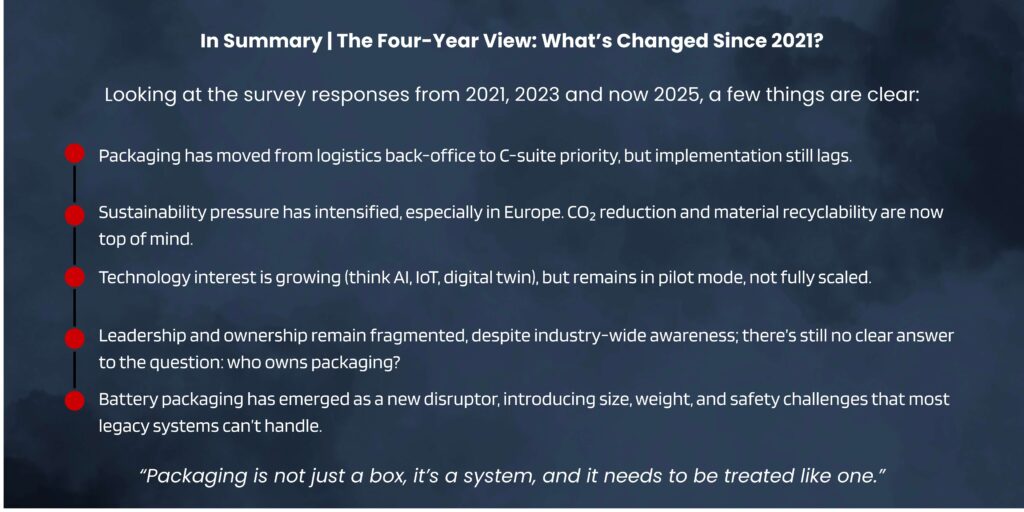
The Three-Year View: What’s Changed Since 2021?

One of the most telling parts of running the Automotive Packaging and Container Management Survey every two years is being able to track how sentiment, strategy, and operational realities shift (or don’t!) over time.

Looking across the 2021, 2023, and 2025 surveys, a pattern emerges: awareness is rising, but execution is still catching up. The industry now knows it has a packaging problem. But whether it’s equipped and resourced to solve it at scale is another question.

From Logistics Concern to Boardroom Topic

In 2021, packaging was still seen primarily as a logistics task: operational, transactional, and low-visibility. Senior executives weren’t particularly engaged unless there was a major cost spike or quality failure.

Fast-forward to 2025, and the tone has shifted. Packaging is now firmly on the radar of C-suite leaders, driven by rising costs, ESG commitments, and regulatory exposure. Yet respondents remain frustrated by a lack of clear leadership and ownership.

“Packaging is on the agenda, but no one owns it. Everyone has an opinion, but no one has a plan.”

This disconnect between visibility and responsibility is one of the defining features of the 2025 data. Senior interest is welcome, but without structural accountability, progress remains fragmented.

Sustainability: From Aspirational to Enforceable

Sustainability has evolved from a side conversation to a strategic imperative. In 2021, “eco-friendly packaging” was largely aspirational, something nice to aim for when time and budget allowed.

By 2023, we saw the first real movement. More companies experimenting with cardboard alternatives, higher truck fill rates, and reusable systems. But it was still mostly self-driven.

Now, in 2025, regulation is taking the lead. The EU’s Packaging and Packaging Waste Regulation (PPWR) is pushing packaging compliance to the top of the agenda, with companies facing increasing pressure to demonstrate recyclability, reduce volume, and account for lifecycle impact.

“Sustainability used to be about image. Now it’s about compliance. And cost. And risk.”

The urgency is palpable, particularly in Europe, but also growing in North America and Asia, where global suppliers are trying to meet divergent standards across multiple markets. The risk of inaction has become too great.

Technology: Still in Trial, Not Yet Transformative

Technology is another area where expectations are outpacing adoption.

In 2021, most respondents were unsure where to start. Tracking technologies (think RFID, barcoding, GPS) were seen as expensive or complex. By 2023, attitudes had warmed: companies were running pilot programmes, exploring smart packaging, and considering IoT and AI for predictive tracking.

By 2025, the appetite is there, but the rollout remains inconsistent. Digital twins, AI-based container forecasting, and integrated visibility platforms are emerging, but typically in isolated cases, not enterprise-wide deployments.

“We have a pilot for every problem, but no one wants to scale anything.”

The lack of standardisation, coupled with siloed budgets, remains a major barrier. Until packaging tech is embedded in cross-functional strategy, within procurement, logistics, sustainability and IT, it risks remaining a perpetual ‘future fix.’

Battery Packaging: The Disruptor No One Fully Anticipated

Perhaps the biggest curveball to emerge in the 2023 and 2025 surveys is the logistical impact of battery and EV component packaging.

In 2021, it was barely mentioned. By 2023, it had become a known challenge. In 2025, it’s seen as a serious disruptor. Battery modules and EV parts bring unprecedented size, weight, and safety concerns. They require specialised packaging, thermal insulation, and rigorous handling protocols.

“Battery packaging is where we realise how little we’ve modernised the system.”

It’s not just a packaging issue; it’s a network design issue. These parts don’t move like traditional components, and their packaging doesn’t return or recycle in the same way. Most existing systems weren’t built for this scale or risk profile.

This is where the gap between innovation and infrastructure becomes particularly stark.

Leadership and Ownership: Still the Missing Link

Across all three surveys, one constant remains: no one really owns packaging. Logistics teams manage it, engineers spec it, procurement buys it, and sustainability teams critique it, and yet no one is accountable end-to-end.

In 2025, this is still the case. And the consequences are familiar: duplicated designs, unused returnables, reactive fire-fighting, and missed opportunities for collaboration.

“Packaging is like the orphan child of the supply chain – everyone sees it, but no one wants to raise it.”

The industry knows it needs a more coordinated, cross-functional approach. But the leadership structures and incentives haven’t yet caught up.

The Core Message

Packaging has made huge strides in visibility over the past four years, but the operational maturity still lags. It’s moved from a logistics line item to a compliance risk, a cost pressure, and a sustainability lever. And yet, many of the same frustrations remain unresolved.

The insight that emerged from the 2021 survey still rings true today, but it’s taken on new weight and urgency:

“Packaging is not just a box. It’s a system and it needs to be treated like one.”

Survey summary

Final Thought: Time to Raise the Game

There’s one thing I’ve consistently seen since I first stumbled into the world of automotive packaging: it only gets attention when something goes wrong.

That’s no longer good enough. As the industry faces regulatory pressure, supply chain complexity, and ESG accountability, packaging must be treated with the strategic importance it deserves.

It’s time we stop calling packaging an afterthought. It’s time we recognise it for what it is: an essential part of product quality, logistics performance, sustainability, and cost control.

If you’re facing similar challenges, exploring collaborative solutions, or simply want to share your own experiences, I’d love to hear from you – louis@lconnect.co.uk.

Thanks again to everyone who contributed to the survey. You’re helping us move the conversation forward.

Next Step: Follow-up webinar

We’ll be hosting a short follow-up webinar to discuss the results and hear reactions from across the industry, so keep an eye on our Interviews page for this.

Thanks to Tri-Wall Circular for supporting this initiative and helping shine a light on packaging’s role in driving supply chain performance and sustainability.
success automotive industry
CategoriesAutomotive Insights, Insights

How do we ensure success in the automotive industry?

The automotive industry is constantly evolving

With the automotive industry evolving, supply chain and logistics leaders need to adapt to the changes to ensure success. Here are some key pieces of advice we have gained from global automotive supply chain and logistics leaders for the leaders of the future:

1. Embrace Change

The VUCA (volatile, uncertain, complex, and ambiguous) world demands supply chain and logistics leaders to be adaptable to new energy, new products, and new technologies.

2. Focus on Supply Chain Resilience

Supply chain needs to be flexible, resilient, sustainable, and reliable. Logistics is a people’s business, so even if automation, AI, and digitalization are implemented, the human element cannot be ignored.

3. Develop Curiosity

Curiosity is a key trait for supply chain and logistics leaders. They should learn by doing, rather than just relying on PowerPoint presentations. Working in logistics provides an excellent opportunity to experience different cultures and languages.

4. Be Sustainable

Supply chain and logistics leaders can change the world by implementing sustainability measures. Logistics should be more present in daily life, and this can be achieved by promoting the importance of logistics to the wider public.

5. Stay Up to Date with Technology

Digitalization, automation, and real-time tracking are essential for the future of logistics. Logistics leaders should develop and monitor their understanding of new technologies, digitalization techniques, and data management.

6. Focus on Leadership Development

Leadership skills are essential for supply chain and logistics leaders. They should seek training, courses, and tools to work with the younger workforce that is emerging.

7. Understand the Industry

Supply chain leaders should understand every step, link, and component in the supply chain, from internal processes to logistics service providers. This understanding will enable them to solve any challenge that comes their way.

8. Be Agile

The future requires agility, which doesn’t always align with commercial interests. Supply chain leaders should be quick to adapt to changes and not rely too much on all-in-one solutions or control towers.

9. Think Globally

Supply chain leaders should think globally and embrace diversity, both in terms of people and where and how they work. They should also balance between managing people and embracing new technology.

10. Expect the Unexpected

Supply chain leaders should build resilient supply chains to overcome unexpected events. The VUCA environment will continue, so they need to stay on their toes.

11. Focus on Data Quality

Supply chain can work like clockwork, but it requires master data quality, process discipline, and data management. This will eliminate politics and lead to intangible benefits.

If you would like to discuss any of these points in our next ‘In Conversation with’ interview, contact Louis at louis@lconnect.co.uk.

Stay Connected

Subscribe to the LConnect Newsletter
A comprehensive resource for industry specialists covering the latest automotive logistics news and insights.

Copyright © 2022 LConnect
Copyright © 2025 LConnect. All Rights Reserved  |  Privacy Policy  |  Cookies Policy